
Market validation helps a startup decide whether the evidence justifies its next investment. Interviews, landing pages, and pilots each answer different questions. Ten positive interviews may support a problem hypothesis while leaving purchasing, delivery, and acquisition economics untested.
This article explains how to evaluate that evidence and choose what to test before funding a build. Here’s a shortcut:
- Assess problem, segment, access, commitment, delivery, and repeatability.
- Match each finding to the assumption it actually tests.
- Check commitments against the price, obligations, and refund terms involved.
- Set decision thresholds before collecting results.
- Choose whether to proceed, revise, pause, or exit based on the investment at stake.
The evidence must be strong enough to justify the next commitment: further research, a paid pilot, or a larger investment. Findings apply to the segment, geography, use case, and buying conditions tested. A successful pilot with one customer does not establish repeatability across comparable customers.
What Market Validation Looks Like in Practice
These three cases show different kinds of evidence: interest before a build, actual purchases, and feedback from people already using a product.
Buffer: interest justified a first build. Joel Gascoigne paused early coding to test a simple website, then added a pricing page. Visitors selected plans and left their email addresses; some clicked paid options. He used that signal to build a working version over seven weeks. The first paying customer arrived within four days of the product launch. The distinction matters: pricing clicks supported the decision to build, while payment provided later evidence of willingness to pay. Read Gascoigne’s account.
Zappos: purchases tested demand before an inventory investment. Nick Swinmurn photographed shoes in local shops and listed them online. When customers ordered, he bought the shoes at retail price and fulfilled the orders. This tested purchasing behavior without first buying a warehouse of stock. Our reading of the experiment: orders supported further investment in the idea, but did not establish that acquisition, fulfillment, and returns would leave a sustainable margin. Read the account of Zappos’ customer experiments.
Superhuman: user feedback changed the segment and roadmap. Rahul Vohra surveyed people who had already used Superhuman, applying Sean Ellis’s 40% “very disappointed” benchmark. The initial score was 22%. Within the narrower target segment, the score was 33%; subsequent product improvements helped it reach 58%. This was a product-market-fit exercise after a product existed. It shows how evidence can change whom a team serves and what it builds next; the survey alone does not establish purchasing behavior or profitable acquisition. Read Vohra’s account.
The Six-Proof Framework for Market Validation
This article organizes market validation into six evidence categories: problem, segment, access, commitment, delivery, and repeatability. “Proof” names the question to investigate; its evidence may still be missing, weak, or contradictory.
A decision is only as reliable as its weakest relevant proof.
This editorial framework draws on Steve Blank’s Customer Development methodology and Eric Ries’s Build-Measure-Learn cycle: treat assumptions as hypotheses to test.
| Proof | Question | Stronger Evidence |
|---|---|---|
Problem | Is the problem real, frequent, and costly enough to justify change? | Observed behavior, workarounds, and measurable costs already being paid |
Segment | Are there enough reachable potential buyers with similar problems to support the business? | Repeated patterns among comparable customers; credible estimate of reachable buyers |
Access | Can the startup reliably reach buyers? | Qualified conversations from a repeatable channel |
Commitment | Will customers sacrifice money, time, data, or reputation? | Deposits, contracts, paid pilots, or letters of intent specifying price, timing, and purchase conditions |
Delivery | Can the solution create value at an acceptable cost? | Successful delivery with measurable outcomes |
Repeatability | Can the result be reproduced? | Multiple comparable customers, references, and workable unit economics |
These proofs are not a fixed testing sequence. Start where uncertainty could change the next investment decision. An unsupported proof may justify a smaller test before a larger commitment.
The Evidence Ladder for Market Validation
The evidence ladder distinguishes stated interest, customer commitment, delivered value, and repeat purchase. It helps interpret evidence rather than assigning a universal score to each category in the six-proof framework.
| Stage | Evidence Type | What It Supports |
|---|---|---|
1 | Customer opinion | An initial understanding of preferences and hypotheses worth investigating |
2 | Reported past behavior | An account of previous problems, purchases, or workarounds that may need corroboration |
3 | Observed behavior | Evidence of what customers actually do in the observed conditions |
4 | Participation in a test | Engagement with the proposed solution; strength depends on the effort and resources involved |
5 | Operational commitment | Willingness to allocate staff time, data, access, or workflow changes |
6 | Financial commitment | Willingness to pay under the tested price and terms |
7 | Realized customer value | Evidence that the solution delivers a useful outcome |
8 | Repeat purchase and referral | Repeat purchases support continued demand; referrals support advocacy. Neither alone establishes sustainable acquisition costs. |
Evidence is stronger when it directly tests the assumption under real buying conditions across comparable customers. Customer sacrifice matters, but it is not the only measure of quality.
These stages are not cumulative.
A free concierge test can demonstrate customer value without establishing willingness to pay.
A paid pilot can demonstrate financial commitment before the promised value has been delivered. Record both conclusions separately.
How to Validate Market Demand: A Seven-Step Process
To validate market demand, define the investment decision and target customer, list the assumptions behind the opportunity, prioritize the riskiest assumption, choose a suitable test, set a measurable success threshold, and use the results to decide whether to proceed, revise, pause, or exit.
Step 1. Define the decision. What are you deciding whether to fund? Name the proposed investment: another test, a paid pilot, product development, or market entry.
Step 2. Define the customer segment. Whose demand are you testing? Specify the buyer, user, use case, geography, company type, and buying conditions. Start with a narrow segment large enough to support the opportunity.
If several customer groups look promising, first choose a beachhead market: the narrow segment where you will concentrate your initial tests.
Step 3. List the assumptions. What must be true for the opportunity to work? Check these assumptions:
- The problem is frequent and costly enough that customers actively want it solved.
- The target segment can be identified and reached through a real channel.
- Customers have the authority and budget to buy, not just the interest.
- The solution can be delivered at a cost that supports a workable margin.
- The sales cycle is short enough for the business to survive while closing it.
Step 4. Rank assumptions by risk. Which untested assumption could make the investment fail? Test that first; leave well-supported assumptions alone for now.
Step 5. Choose the cheapest credible test. What is the least expensive test that could answer that question? Use the methods below before committing to product development.
Step 6. Set the threshold before testing. What result would justify proceeding, revising, testing again, or exiting? Write the threshold down before collecting results.
Recording decision thresholds beforehand prevents success criteria from shifting to fit the results. The Center for Open Science’s preregistration guidance recommends recording hypotheses and analysis decisions before outcomes can influence them.
Worked threshold example. A test reaches 20 qualified prospects and costs $1,200, including all acquisition costs. Before testing, the team sets a maximum acquisition cost of $400 per paying customer. It therefore needs at least three paying customers: $1,200 ÷ 3 = $400, or a 15% conversion rate.
The $400 ceiling is hypothetical, not an industry benchmark. Justify your own ceiling against margins, retention, and available cash. Three conversions would support another acquisition test under comparable conditions; they would not establish a scalable channel.
Step 7. Record the evidence and decide. What did the test show, and what will you do next? Update the six-proof framework, identify the gap that matters most to the proposed investment, and decide what the evidence supports.
Which Market Validation Methods Should You Use?
Use interviews to investigate problems, transaction tests to check commitment, and concierge tests or pilots to measure value. Choose the method that addresses the unresolved assumption in the six-proof framework.
Customer interviews
Use interviews when the problem or segment is unclear. Ask about recent incidents, workarounds, and spending. Check those accounts against observation; interviews alone do not establish purchasing behavior.
Landing page demand tests
Use a landing page to test a message or offer. Track the action requested: a signup shows interest; a genuine purchase or deposit tests financial commitment. Record price, traffic source, and refund terms. Neither result establishes delivered value or repeat demand.
Concierge tests
Use manual delivery to test value before engineering begins. Measure the customer’s outcome and your delivery cost. The result does not establish automated delivery costs or acquisition at scale.
Letters of intent, design partnerships, and paid pilots
Use these to test what a customer will commit. Record purchase obligations, staff time, data access, and payment. A non-binding LOI differs from a paid pilot; assess the terms rather than assuming a fixed ranking. Neither guarantees renewal.
Secondary and competitive research
Use existing research to size the segment and understand alternatives. Examine buyer numbers, current spending, and competitors. This scopes the opportunity without establishing commitment to your offer.
Surveys
Use surveys to estimate how common a problem or preference is after interviews clarify what to ask. Define the population and measure responses within it. Hypothetical purchase answers indicate stated willingness to pay; check them through real offers.
Pre-orders and deposits
Use pre-orders or deposits to test financial commitment before full delivery. Record amounts paid, cancellations, and refund rights. A small, freely refundable deposit provides different evidence from a completed purchase at the intended price; neither establishes successful delivery.
Sales outreach
Use outreach to test access and the buying process. Track contact-to-conversation-to-commitment rates and elapsed time. Replies alone do not establish demand or sustainable acquisition cost.
How Do You Test Willingness to Pay and Validate Pricing?
Test willingness to pay by offering a real purchase, deposit, or paid pilot at a stated price and observing whether customers commit. To validate the economics as well, track three things together:
- The price paid and any discounts or conditions needed to close.
- Time from first contact to signed commitment and payment.
- Acquisition and delivery costs relative to the gross profit the customer is expected to generate.
Customers can value a product and pay for it while the business still loses money serving them.
Compare expected lifetime profit with cash payback: a sale that looks profitable over several years may still take too long to fund the next one. Demand validation informs the wider technology commercialization decision, including how the technology will reach customers and generate revenue.
Do You Need an MVP for Market Validation?
No, market validation does not always require an MVP. Build a minimum viable product when the next decision requires customers to use a functioning product to test adoption, delivered value, or continued use.
For earlier questions, use the narrower instrument: interviews and observation for the problem, a technical proof of concept for feasibility, and a prototype for usability. These tests can overlap, but technical success leaves acquisition cost, sales-cycle length, and procurement approval unanswered.
Before commissioning the MVP, assign technical ownership before the first build, including responsibility for architecture, build-versus-buy decisions, and engineering hiring.
How Does B2B Market Validation Differ From B2C?
B2B market validation often involves identifiable buyers and formal approval. The worked examples focus on budget approval, paid pilots, and sales cycles. The six-proof framework also applies to consumer markets, but the evidence must reflect how those customers discover, buy, and use the product.
B2B and B2C validation test the same questions using evidence suited to account-based or individual buying decisions.
| Proof | B2B Examples | Consumer Examples |
|---|---|---|
Commitment | A paid pilot, purchase order, or contract with defined obligations | A completed purchase, pre-order, subscription, or deposit |
Access | Qualified prospects reached through repeatable outreach, partnerships, search, or marketplaces | Customers reached through paid advertising, organic search, communities, partnerships, or referrals |
Repeatability | Renewals, repeat purchases, and delivered value across comparable accounts | Retention, repeat purchases, and delivered value across comparable customer cohorts |
Choose tests that match the buying context. A consumer transaction test may be more useful than a sales call, while an enterprise purchase may require procurement and security approval before payment is possible.
Market Validation Example: B2B Logistics Analytics
This hypothetical scenario applies the six-proof framework to a B2B investment decision.
Problem proof. Operations teams at mid-size logistics companies track delivery exceptions in spreadsheets. Interviews reveal each exception costs an estimated two to four hours of manual reconciliation. If the existing workaround is good enough, that cost may still be insufficient to motivate switching.
Segment proof. The pattern repeats across logistics operators running 50–500 vehicles and using one of three common fleet-management platforms. This defines a segment to investigate; reachable buyer numbers and spending still need validation.
Access proof. A partnership with one fleet-management platform's integration marketplace provides a route to qualified operations leads. Whether the channel can produce those leads repeatedly and at an acceptable cost remains to be tested.
Commitment proof. Three operators agree to a 90-day paid pilot at a reduced rate.
Delivery proof. Before testing, the startup sets a success threshold of a 30% reduction in reconciliation time. The three pilots produce reductions between 34% and 41% against that threshold.
Repeatability proof. The same reduction appears independently across all three pilot operators, rather than being concentrated in one unusually motivated customer. This is early repeatability evidence — strong enough to justify testing a larger customer cohort, but not yet enough to claim a scalable market.
Market Validation Scorecard
Figures and thresholds are illustrative; a real team would set them from its own economics, risk, and next investment decision.
The completed scorecard connects each assumption to the evidence collected, its limits, and the next test needed.
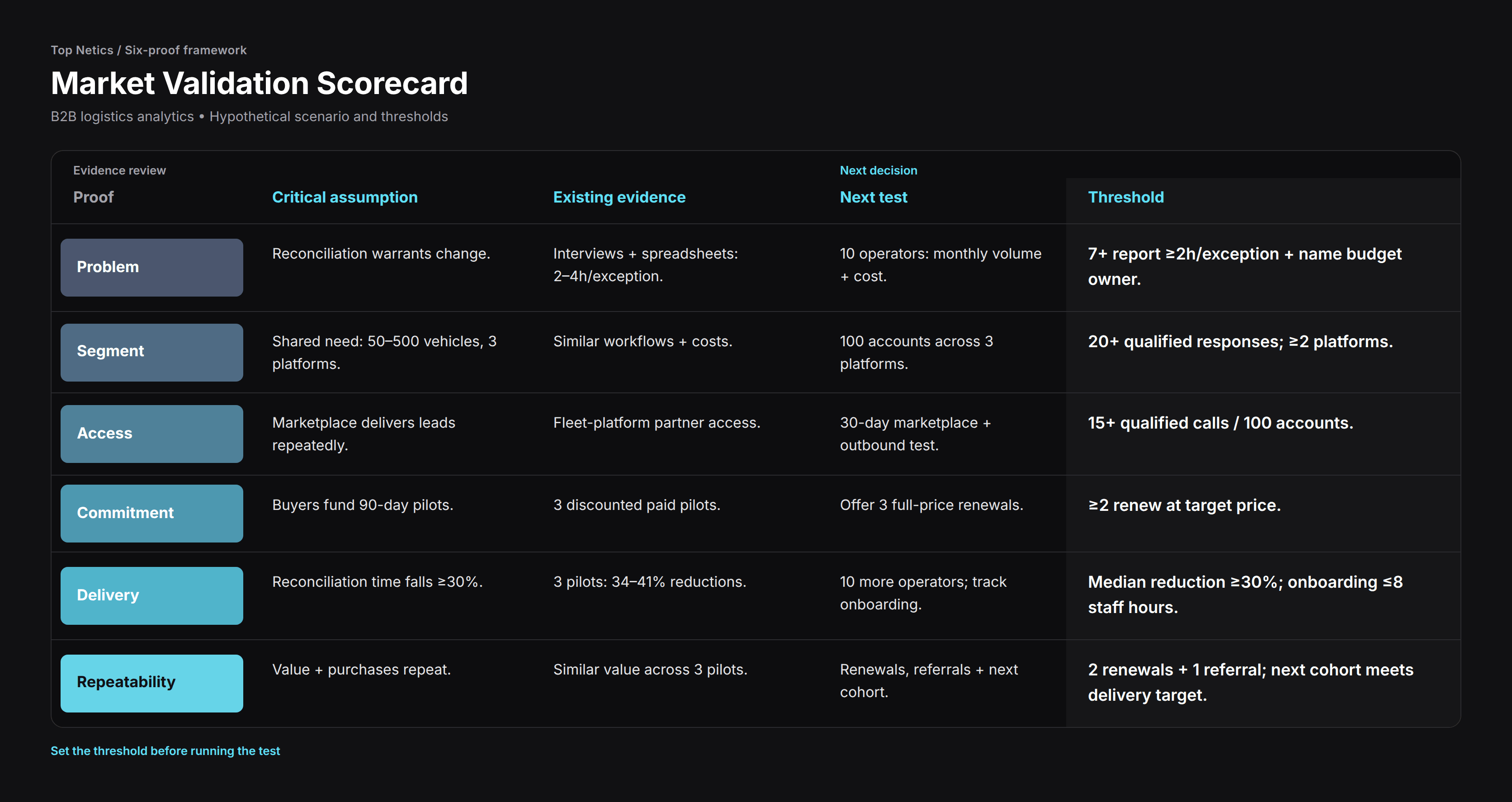
The next planned investment determines which gap matters most.
Before increasing acquisition spend, test channel conversion and cost. Before expanding delivery, test onboarding effort and margin. Before assuming recurring revenue, test renewal at the intended price.
How Does Market Validation Differ From Market Research and Product Validation?
Market research describes the opportunity, product validation tests usability and value, and market validation tests whether reachable demand can support a business. Let’s review related concepts and the principal questions:
- Market research: What does this market look like? Describes customers, competitors, and market size.
- Problem validation: Does this customer experience an important problem?
- Solution validation: Does the proposed approach make sense to them?
- Product validation: Can people use the product and get the intended value?
- Market validation: Is there credible, reachable, and commercially viable demand in a defined segment?
- Product-market fit: Is demand becoming repeatable, efficient, and sustainable at scale?
Product-market fit requires sustained acquisition, purchase, and value delivery at workable economics. Early repeatability evidence can justify further testing without meeting that standard. The article on market entry framework addresses the additional attractiveness and right-to-win questions behind a full entry decision.
Six Market Validation Criterias
Use the six-proof framework to review the evidence against the criteria set before testing, then choose the next action.
Proceed. The evidence is sufficient for the specific next commitment, and unresolved questions are explicitly carried into the next test. When the build begins, technical debt governance should be assigned before the first architecture decision is made. A small experiment may proceed while several proofs remain uncertain; a larger investment requires stronger support for the assumptions it depends on.
Revise. Some proofs are strong and others are weak or contradictory. The segment, the offer, or the price may need to change before testing again — not the whole idea.
Pause. The evidence is inconclusive. Hold the larger investment while resolving the missing evidence through a limited test, or wait until access, timing, or resources make testing possible.
Exit. One or more proofs have failed decisively, and no credible revision path exists. Continuing to invest at this point is a bet against the evidence, not a bet informed by it.
Before You Fund the Build, Decide What Still Needs Testing
Positive interviews, a growing waitlist, or one successful pilot can leave important questions unanswered. Which customers will pay? Can you reach more of them? What will delivery cost?
Outside support is most useful when you are about to commission an MVP, have interested prospects but no paying customers, or need to decide whether a successful pilot justifies further investment.
Top Netics’ published Performers AI example describes testing computer vision against real competition footage. Changes in lighting and camera angles exposed problems that clean footage had not revealed. For a founder planning a build, the lesson is practical: test under the conditions the product will encounter. This example demonstrates technical validation experience; customer demand requires its own evidence.
You do not need a finished specification. Bring your target customer, what you have tested, and the investment you are considering. Use the first conversation to discuss whether the next step is another demand test, a technical experiment, or product scoping—and what support that step would require.
Discuss what to validate before you build