
Technical debt in startups is a governance problem: the question is never whether shortcuts were taken, but whether a named person in your structure owns which shortcuts are acceptable, which get documented, and which get repaid before they limit a funding conversation or a scaling decision. Top Netics has worked as startup CTO partner and technical co-founding studio across AI, blockchain, fintech, and computer vision ventures across seven countries. Our governance chain comes from making architecture decisions under funding constraints, hiring constraints, and product deadlines across twenty ventures.
Most founders treat technical debt the way they treat legal risk: it exists, someone should deal with it, and the right time to deal with it is after the next milestone.
Startups rarely choose technical debt. They inherit it from yesterday’s deadline.
As per McKinsey & Company research, CIOs claim that technical debt makes up 20% to 40% of their total technology estate value before depreciation. That’s not a feature of early-stage startups specifically. It’s what happens when the decision of which shortcuts are acceptable is left unassigned. A peer-reviewed longitudinal study found developers losing an average of 23 percent of their working time to it (Besker, Martini, and Bosch). The cost compounds quietly, across every sprint, until it surfaces in a due diligence process or a scaling failure.
Developers introduce shortcuts. That’s often the correct decision. Leadership decides which of those shortcuts become acceptable technical debt, which get documented, and which get repaid. When that distinction collapses, debt becomes invisible until it’s expensive.
This guide covers what technical debt actually is, the seven types a startup carries, the signals that precede the benchmarks, two techniques for paying down debt without halting development, and how naming a technical debt owner converts compounding risk into a manageable business variable.
What Is Technical Debt in Startups?
Top Netics treats technical debt as a governance system rather than a code-quality problem. The distinction changes who owns the decision, what the fix looks like, and when it becomes expensive enough to affect fundraising. A startup with perfect code and no named debt owner has a governance problem. A startup with known shortcuts and a repayment plan is in a manageable position.
Ward Cunningham coined the term in 1992 with a deliberately financial analogy. “A little debt speeds development,” he wrote, “so long as it is paid back promptly with a rewrite. The danger occurs when the debt is not repaid.” Martin Fowler later mapped the idea along two axes: deliberate versus inadvertent, and reckless versus prudent. The most dangerous combination is reckless and inadvertent. Shortcuts taken without anyone recognizing their long-term cost. The most manageable is prudent and deliberate, taken knowingly with a repayment plan already attached.
Technical debt also hides value a company has already paid to create. Deloitte’s research names this “latent potential”: the portion of a technology’s value that stays trapped and unusable because debt’s complexity obscures it. Features half-built on a shaky foundation, data nobody can easily query, integrations nobody trusts enough to build on. Repaying technical debt isn’t only about avoiding future cost. It’s about recovering value the company already funded.
Is Technical Debt Always Bad?
No. Good technical debt is deliberate, documented, and temporary. A startup that spends three extra months building a perfectly scalable architecture for a product nobody has validated yet has usually made a worse decision than one that shipped imperfect and found out whether anyone wanted it. What makes debt dangerous is not its existence. It’s its invisibility.
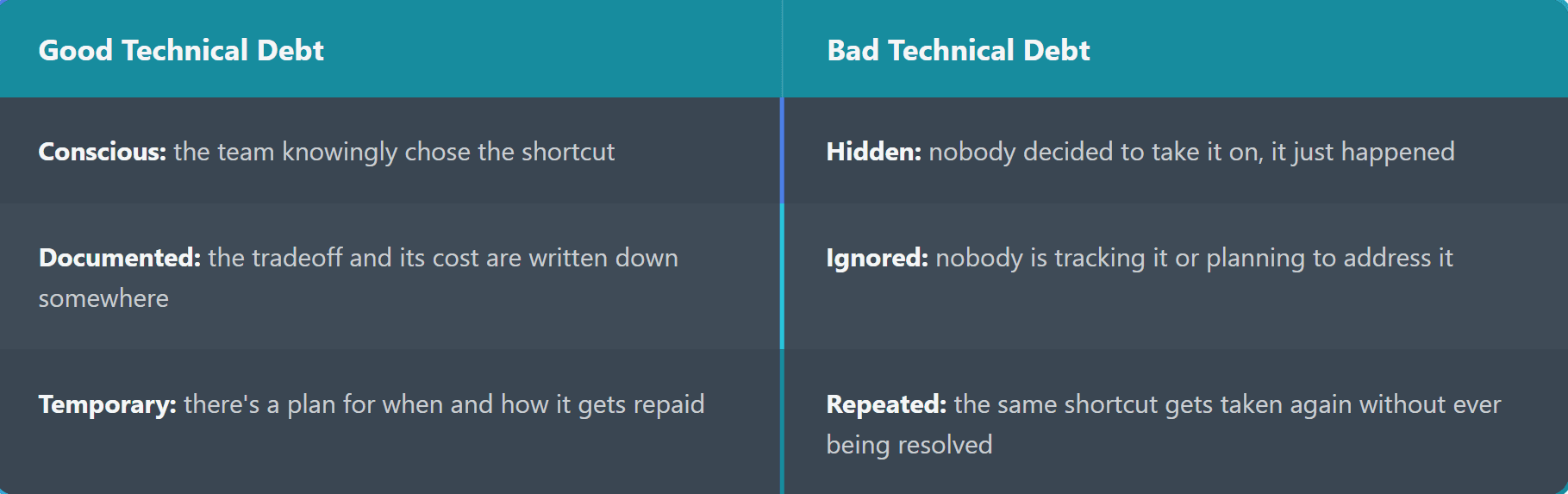
The distinction that matters is not how much debt exists. It’s whether a named person knows which debt exists and has a plan for it. Documented debt is manageable by design. Undocumented debt has to be discovered before it can be managed at all, and discovery tends to happen at the worst possible moment.
The Seven Types of Technical Debt in Startups
The ones that compound fastest are usually the ones nobody named.
Technical debt in startups falls into seven categories, each with a different risk profile and a different cost to repay.
Deliberate debt
A shortcut taken knowingly, with the team aware of the tradeoff and what repaying it will require. The most manageable type because it’s visible from the start.
Accidental debt
A shortcut nobody chose on purpose, usually the result of a decision made without knowing its long-term consequence. It has to be discovered before it can be addressed, which is why it’s more dangerous than deliberate debt of the same size.
Architecture debt
A structural decision, a monolith or a tightly coupled service, that becomes expensive to change once other decisions are built on top of it. The type most likely to turn a scale transition into a full rebuild rather than an upgrade.
Infrastructure debt
Temporary infrastructure choices, a single server or a manual deployment process, that were reasonable at low scale and aren’t at higher scale. It rarely feels urgent until it suddenly is.
Documentation debt
Decisions and systems nobody wrote down. It makes onboarding a new engineer or a startup CTO partner far slower than it should be, and it means the reasoning behind past decisions disappears with whoever made them.
Testing debt
Automated testing skipped to ship faster, trading a small amount of near-term speed for a growing amount of risk each time the untested code is touched.
Security debt
Security practices deferred under time pressure. It is the type of technical debt most likely to become a business-ending event rather than a slowdown, and the type where deferred cost is least predictable.
Architecture and security debt don’t stay manageable over time the way documentation or testing debt can. Architecture debt that worked at ten users can make a Series A a structural rebuild instead of a funding event. Security debt that seemed low-stakes at seed can become a compliance or breach event at growth stage. Both need a named owner and a repayment timeline attached, not a team assumption.
Who Owns Technical Debt in a Startup
Shared accountability for technical debt is the same as no accountability.
Technical leadership owns it: a named person with real authority over architectural decisions.
A developer can introduce a shortcut under deadline pressure, and it’s often the right call. What creates compounding risk is when the decision of which shortcuts matter is left to whoever happens to be working on the relevant part of the codebase. That’s not ownership. That’s diffusion, and diffusion is how debt becomes invisible until it surfaces in due diligence.
In practice, that ownership sits with a CTO as a service partner before the company can support a full-time hire, or with a technical co-founder from the earliest architectural decisions. The governance structure doesn’t need to be elaborate. It needs to be named.
The Technical Debt Governance Chain
Every shortcut should be traceable through this sequence before it’s accepted. Top Netics uses this as a diagnostic when assessing a startup’s debt posture, and as a reference frame for any future architecture or due diligence decision:

A shortcut that can’t be traced past the first step isn’t a deliberate debt decision. It’s an accident in progress. Every Top Netics article that touches technical debt, architecture review, or due diligence preparation will reference this chain.
Five Habits That Keep Debt Under Control
Identification: Name where shortcuts exist before they surface as an outage, a failed audit, or a due diligence question. Debt that can’t be named can’t be prioritized.
Prioritization: Not all debt is equally dangerous. Security and architecture debt that blocks scaling outranks a messy but low-traffic internal tool. This judgment call belongs to technical leadership.
Documentation: Write down what shortcut was taken and why. A technical co-founder or new engineering hire who can read the reasoning behind past decisions onboards in weeks. Without it, they start from scratch.
Ownership: One specific person accountable for tracking and repaying debt. Not a shared sense that the team will eventually get to it. Shared accountability for technical debt is the same as no accountability.
Repayment strategy: A real plan tied to the roadmap, with specific items scheduled for repayment. Debt that isn’t on the roadmap doesn’t get paid down. It gets inherited.
If you’re not sure whether your technical debt has a named owner, a no-cost technical assessment can map what exists and who should own it before the next architecture decision is made. Book a session with Top Netics.
When Technical Debt Becomes a Real Problem
Engineers notice it long before dashboards do.
Features that should take hours take days. A new hire spends weeks understanding the codebase before touching anything. The same category of bug reappears after being fixed. These are the signals. The metrics arrive later.
When they do: Besker, Martini, and Bosch tracked 43 developers over seven weeks and found they lost an average of 23 percent of their working time to technical debt. Stripe’s survey puts the combined figure higher, at 42 percent, when bad code is included. A separate study across 15 large organizations found only 7.2 percent track it methodically at all, which explains why these numbers accumulate without anyone noticing until they’re already expensive. Deloitte’s 2026 Global Technology Leadership Study estimates technical debt accounts for 21 to 40 percent of total IT spending at large organizations. The exact figures differ between startups and enterprises. The underlying pattern doesn’t.
When to Refactor
Not “when we have time.” That moment rarely arrives on its own.
The right trigger is a named judgment: the cost of carrying a specific piece of debt now exceeds the cost of fixing it. That calculation tends to cluster around funding stages. Seed-stage debt is usually survivable. Series A debt starts constraining hiring and scaling decisions. Debt unaddressed heading into a growth stage usually means rebuilding under pressure, consuming runway the company needed for product development instead. The person with the authority to make the call is the technical owner.
Two Techniques That Work
The Strangler Fig Pattern: Build the replacement system alongside the old one, gradually route traffic from old to new, and remove the old system only once the new one is handling everything. This lets a startup repay architecture debt in stages, with a working product at every point, rather than betting on one large rewrite that almost always takes longer than estimated and produces a new codebase with a different set of problems. eBay’s platform modernization applied this at enterprise scale: moving to an API-centric model and refactoring middleware into microservices incrementally, reporting a 100 percent improvement in buyer satisfaction scores as a result (Brillio). The company is far larger than any startup reading this. The underlying move, modernize in stages while keeping the system running, applies at any size.
The Boy Scout Rule: Leave the code slightly better than you found it every time you touch it. This doesn’t replace a deliberate repayment plan. It prevents debt from accumulating faster than scheduled repayment can address. Small consistent improvements compound the same way debt does, just in the right direction.
How Technical Debt Affects Fundraising and Due Diligence
Investors almost never discover technical debt. They discover whether founders already know it’s there.
Consider two founders at the same stage, both raising a Series A for fintech products with comparable revenue. One walks into due diligence able to name the architecture decisions they made, the shortcuts they took deliberately, and the repayment plan for the items that matter. The other can’t answer which debt exists because nobody tracked it. Same stage. Same revenue. One has a named technical owner with a debt inventory and a timeline. The other has a diffuse team assumption that someone was keeping track.
A technical advisor identifies the difference in the first thirty minutes of a codebase review. The first conversation results in deal terms. The second generates a list of follow-up questions that delays the close by four to six weeks and produces a valuation adjustment reflecting the estimated remediation cost.
The technical due diligence process is built to surface exactly this. A technical advisor isn’t looking for a perfect system. They’re looking for evidence that the debt that exists was taken on deliberately, that someone knows what it is, and that there’s a repayment plan for the parts with the highest business consequence.
When investors ask about technical risk, they’re asking a proxy question. What they want to know is whether the team can execute technically without producing surprises they didn’t see coming. Answer that directly: name who owns the debt decisions, what debt currently exists, and what the repayment timeline is for the highest-consequence items. That’s the conversation. Not code quality in the abstract.
Does AI Coding Change How Technical Debt Works?
Yes, in both directions. AI tools make it faster to create technical debt, since working-but-messy code is now nearly instant to generate, and faster to pay it down, since the same tools are genuinely capable at refactoring within a codebase someone already understands.
AI makes debt faster to write. It doesn’t make it easier to own.
The specific risk is accepting AI-generated code without architecture review, sometimes called vibe coding. The result is a codebase full of debt nobody actually understands, including the engineers who nominally wrote it. Engineers who can’t explain the system they’re working in can’t safely modify it without introducing new failures. New hires brought in to accelerate output spend their first months reverse-engineering what exists instead. The debt’s operational cost compounds through the hiring process.
Deloitte’s research makes the broader point directly: most organizations can’t layer AI initiatives on top of an aging foundation and expect the foundation to improve. AI changes the speed at which code gets written. It doesn’t change the requirement that someone owns the architectural decisions, including the ones generated by a tool. If anything, the governance requirement increases when AI accelerates output, because the volume of decisions that need ownership grows faster than any individual engineer can.
Conclusion
Does your structure include a named person who owns which shortcuts are acceptable, which get documented, and which get repaid before they surface in a due diligence process or a scaling failure? If debt ownership is diffuse, shared by the team, or simply unassigned, that is the gap. It doesn’t require a full-time hire to close. It requires a named person with real authority and the Technical Debt Governance Chain applied to every shortcut from here forward.
Technical debt doesn’t end companies. Unowned technical debt, discovered at the wrong moment, does.
Name the owner before that moment arrives.