
The modern business environment no longer functions within the illusion of predictability. Organizations have transitioned from the relatively manageable VUCA model to the harsh realities of a BANI world (brittle, anxious, non-linear, incomprehensible).
In Ukraine's operational context, BANI is not a theoretical abstraction. It is daily operational reality. Ongoing attacks on energy and digital infrastructure, air raid alarms during executive meetings in the Hero City of Bucha, severe labor shortages, and sudden financial or supply chain disruptions demand a fundamental evolution in leadership style.
The cause-and-effect chain of manual oversight
When external turbulence escalates, an inexperienced manager's default impulse is to tighten control and attempt to oversee every detail personally. However, in a BANI environment, this reaction triggers a destructive chain of cause and effect:
Traditional micromanagement creates a catastrophic single point of failure. The business degrades into a fragile system where no process moves without explicit executive approval. If the owner becomes unavailable due to illness, exhaustion, or connectivity loss, operations ground to a complete halt.
As part of the "Rebuild 2: Rebuilding for the Future" initiative, implemented in the Kyiv region by Diia.Business Bucha with financial support from the German Federal Ministry for Economic Cooperation and Development (BMZ), Aktion Deutschland Hilft (ADH), and in cooperation with ASB Ukraine, we conducted an executive leadership workshop. Across in-person sessions in Bucha and interactive online cohorts, we dissected how to break this cycle of manual control and construct a truly self-sustaining team.
This playbook provides an expanded narrative breakdown outlining the direct cause-and-effect links between leadership behaviors and team outcomes.
1. The leader's framework: four pillars of team resilience & their causal dynamics
Organizational resilience during crises does not happen by chance. It is the direct outcome of intentionally engineering four core structural pillars:
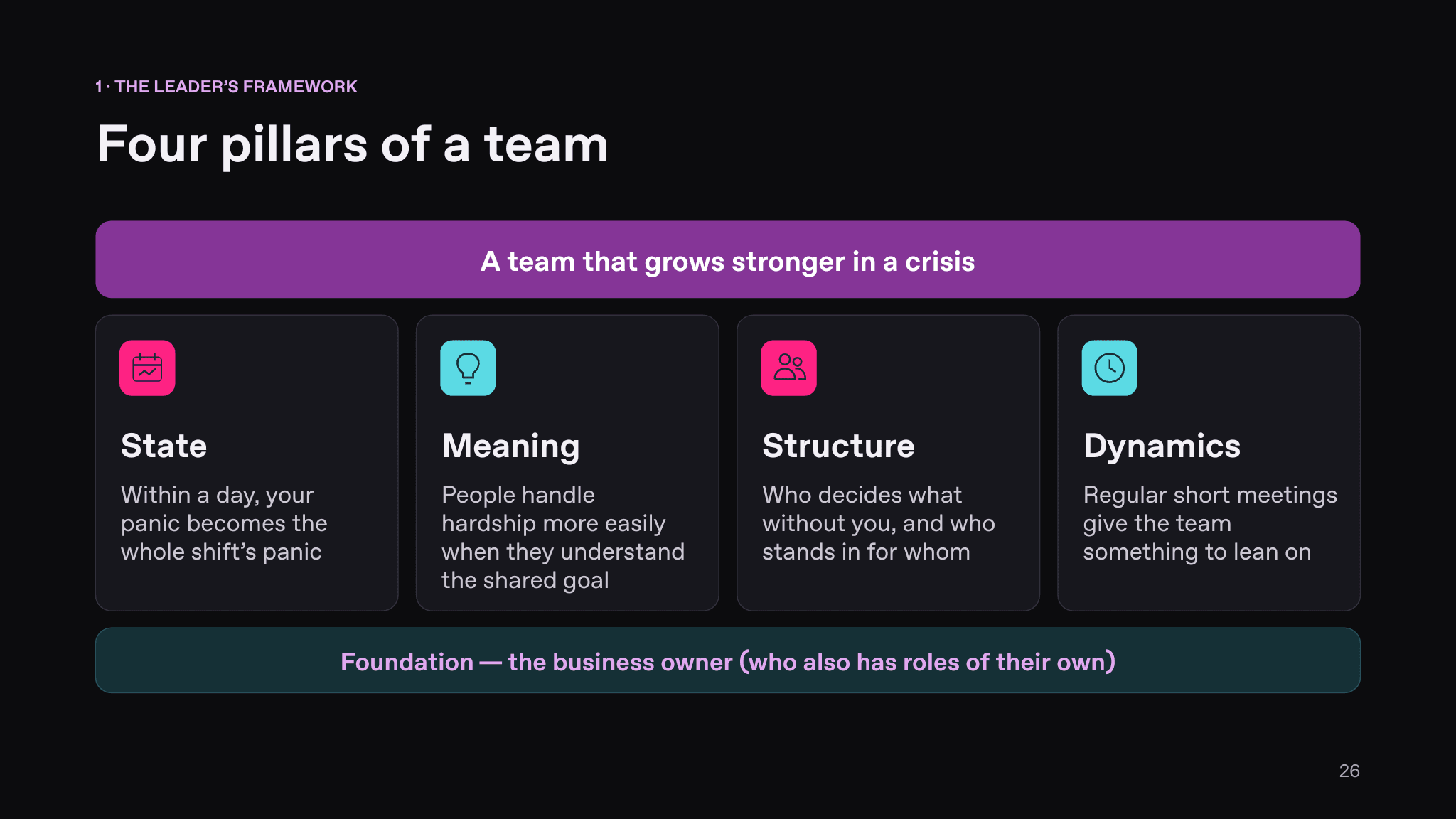
Pillar 1. State: emotional contagion
Pillar 1 turns the leader’s composure from a private matter into a shared asset, so the team takes its cue from calm instead of panic.
- Root cause: A leader's emotional demeanor spreads through an organization with multiplicative force. If an executive displays panic or disorientation, the team absorbs that signal instantaneously.
- Mechanism: Executive anxiety triggers the neurobiological "fight-or-flight" response across staff (SCARF model), paralyzing cognitive problem-solving.
- Consequence: The entire company descends into operational chaos within 24 hours, making reactive mistakes.
Executive tool (the oxygen mask rule): Leaders must stabilize their own internal state PRIOR to engaging their team (take a breath, drink water, 10 minutes of silent meditation). A calm leader creates psychological safety where staff remain focused.
Pillar 2. Meaning: navigational alignment
Pillar 2 turns a list of tasks into a shared objective, so the team adjusts on site instead of sending every decision to the owner.
- Root cause: Operating without strategic context forces employees to seek permission for every minor variation.
- Mechanism: When staff understand only isolated tasks without grasping the broader daily objective, any unexpected hurdle halts progress.
- Consequence: All operational friction escalates back to the owner's desk.
Executive tool (commander's intent): Articulating the core objective and boundaries in a single clear sentence. Bakery example: "Today's priority is delivering to schools on time at 7:00 AM. Recipe adjustments can be made on site, but delivery deadlines are non-negotiable." With clear Meaning, the team independently adjusts production during power outages.
Pillar 3. Structure: role vs. position clarity
Pillar 3 turns each key function from one person’s job into a covered role, so work continues during leave or illness without the owner stepping in.
- Root cause: Conflating formal job titles with operational roles.
- Mechanism: Relying on single individuals for key functions without cross-training creates severe operational vulnerability.
- Consequence: Owner is forced to step in as an emergency replacement during staff leave or illness.
Executive tool (role & redundancy matrix): Decoupling "Position" (formal employment title) from "Role" (operational responsibility). Every critical function must have at least one assigned peer backup
Pillar 4. Dynamics: predictable rhythm
Pillar 4 turns oversight from a reaction into a schedule, so the team knows when review comes and what it will cover.
- Root cause: Oversight that arrives at random. The owner checks in when anxiety spikes, so the team cannot predict when review will come or what it will cover.
- Mechanism: Unpredictable scrutiny reads as a threat. Staff respond with fear and anxiety and conceal mistakes instead of reporting them. This is the Tier 1 failure in Lencioni’s model: absence of trust leads to hidden errors.
- Consequence: Errors surface late, after they have grown. The owner answers with even more random oversight, and the cycle feeds itself.
Executive tool (operational pulse): A fixed cadence of daily and weekly syncs. The article’s own cadence is daily 10-minute standups, weekly metric reviews, and biweekly 1:1s. Review happens on a schedule, so the team knows where problems get raised and the owner stops checking outside it. The pulse also carries the delegation path: the Check stage’s pre-agreed checkpoints and the Trust stage’s reporting “within the team’s regular operational rhythm” run on the same schedule.
| Pillar | Root Cause of Failure | Systemic Consequence | Executive Tool Solution |
|---|---|---|---|
1. State | Leader's unmanaged anxiety | Panic spreads across team in 24 hrs | Oxygen Mask Rule: Stabilize self before communicating |
2. Meaning | Task execution without context | Team halts and awaits orders upon errors | Commander's Intent: Core objective & boundaries in 1 sentence |
3. Structure | Single point of failure per title | Business freezes during employee leave | Backup Matrix: Designate 1+ peer backups per key role |
4. Dynamics | Random, unpredictable oversight | Fear, anxiety, and hidden mistakes | Operational Pulse: Fixed cadence of daily/weekly syncs |
2. From micromanagement to autonomy: the managed delegation path
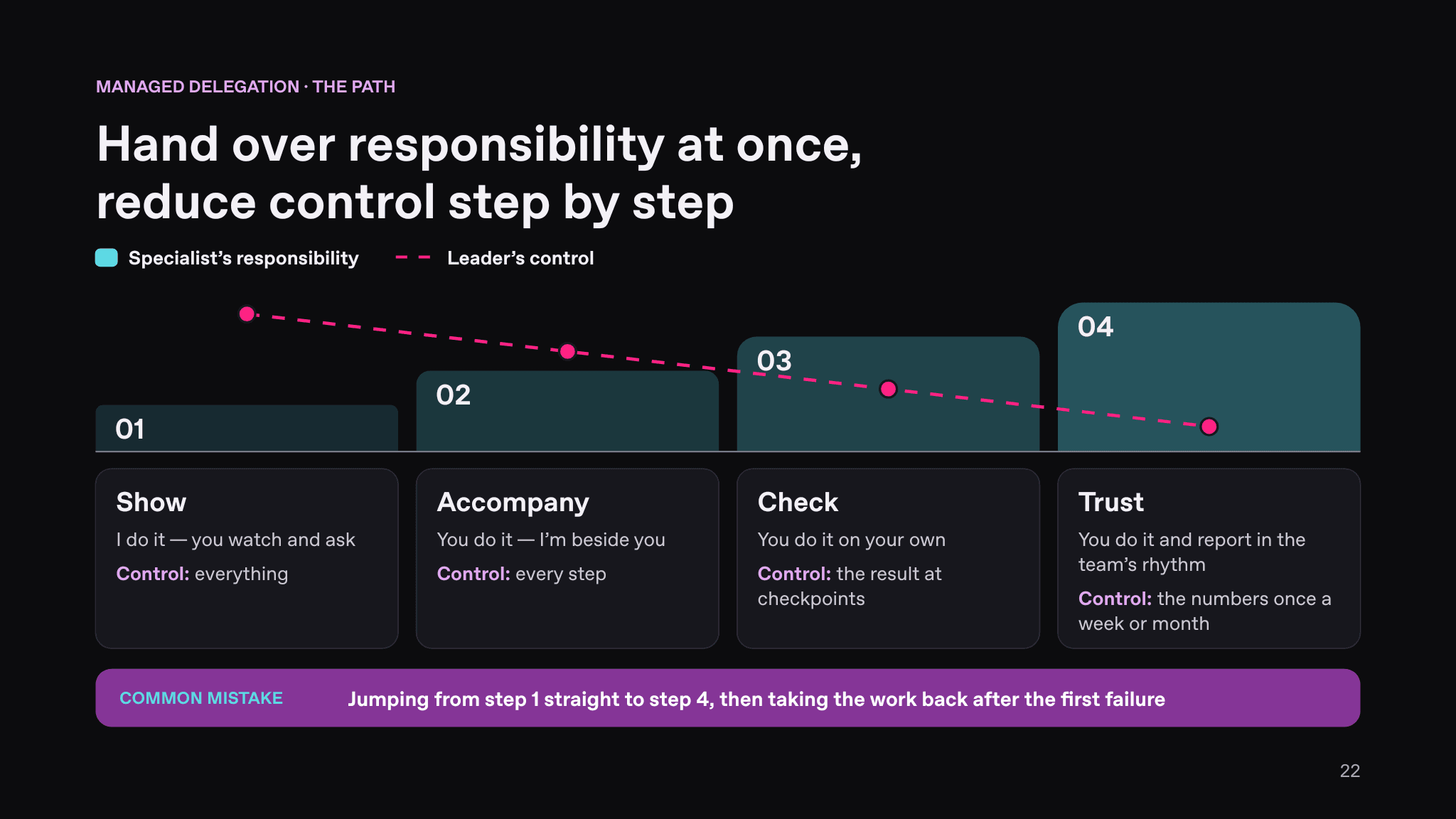
The most frequent managerial failure is the "delegation jump."
- An exhausted business owner abruptly hands over a major responsibility: "You are now fully in charge of raw material procurement" (Jumping directly from Step 1 to Step 4).
- The unprepared employee makes an inevitable mistake: ordering incorrect supplies or missing a vendor deadline.
- The owner reacts emotionally, concluding: "No one can do this properly except me!"
- Outcome: The owner snatches the work back, and the employee surrenders all initiative.
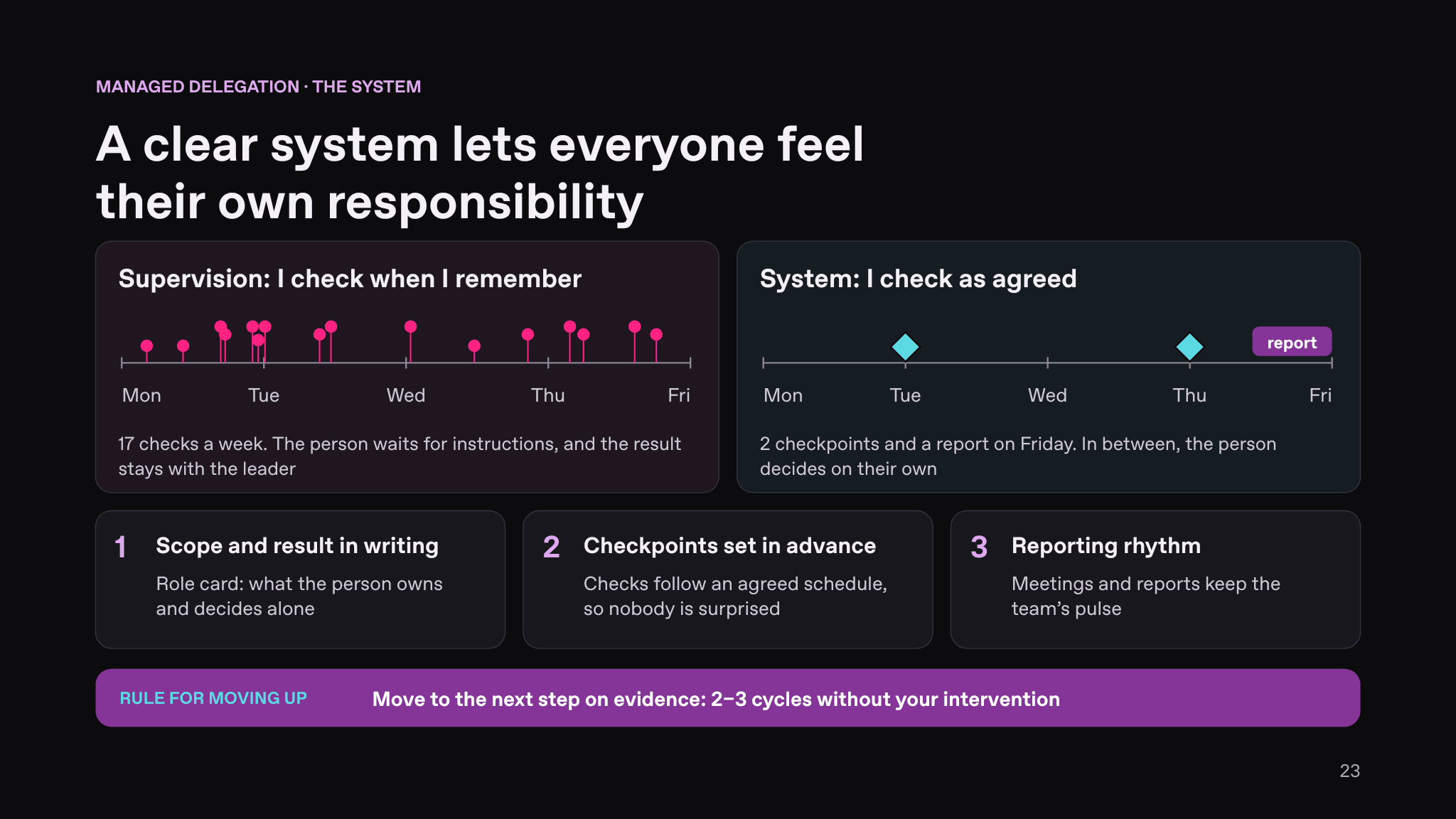
The 4 progressive stages of managed delegation
Top Netics methodology replaces emotional delegation jumps with a structured four-stage evolution:
- Show: The leader executes the task while the specialist observes, takes notes, and asks clarifying questions. Control level: 100%.
- Accompany: The specialist performs the task with the leader standing beside them to guide execution and prevent costly errors. Control level: Step-by-step guidance.
- Check: The specialist operates independently, but outputs are verified at pre-agreed checkpoints. Control level: Scheduled check-ins.
- Trust: The specialist owns the process end-to-end and reports strictly within the team's regular operational rhythm. Control level: Key metrics only.
- Evidence-based transition rule: Advance an employee to the next stage of autonomy only after they successfully complete 2–3 full operational cycles without leader intervention.
3. Second-order consequences & Patrick Lencioni's 5 tiers of team health
Two frameworks show why leadership behavior pays off or fails over time. Ray Dalio’s first- and second-order consequences separate quick results from lasting damage, and Patrick Lencioni’s five tiers show how team dysfunction builds from the bottom up, starting with trust.
Ray Dalio's principle: first- vs. second-order consequences
Short-sighted leadership focuses exclusively on immediate outcomes while ignoring long-term systemic decay:
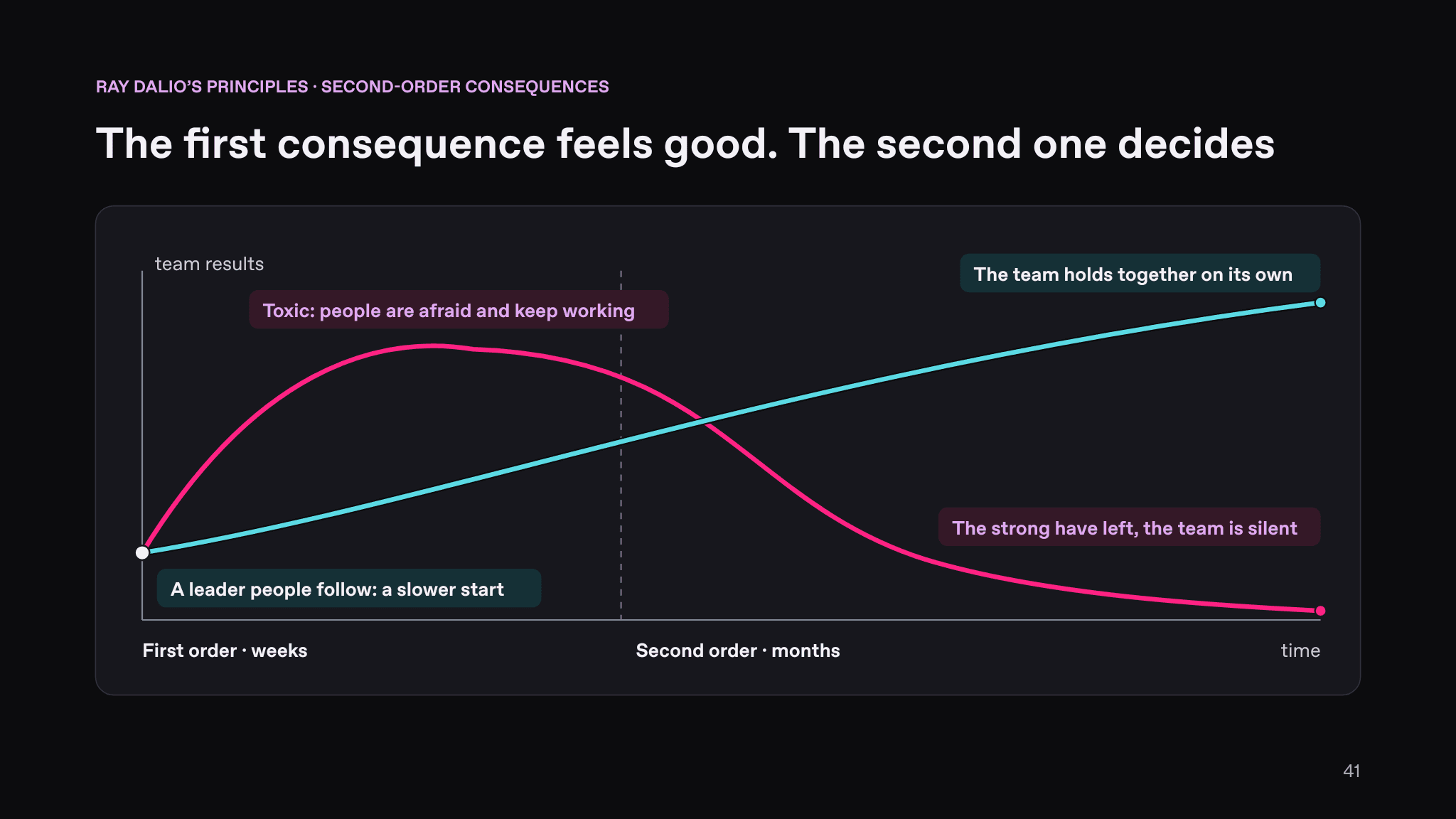
Here's what fear-driven micromanagement introduces:
- First-order consequence (deceptively positive): Intimidated staff work frantically, producing a short-term output spike over the first two weeks.
- Second-order consequence (devastating & decisive): Top talent quietly resigns, remaining staff hide errors, innovation dies, and the company degrades into a passive "Team B."
Here's what trust-based systemic leadership introduces:
- First-order consequence (slower initial start): Upfront time is invested in training, documenting SOPs, and cross-training backups.
- Second-order consequence (enduring resilience): The team evolves into an autonomous "Team A" capable of thriving independently during severe market disruptions.
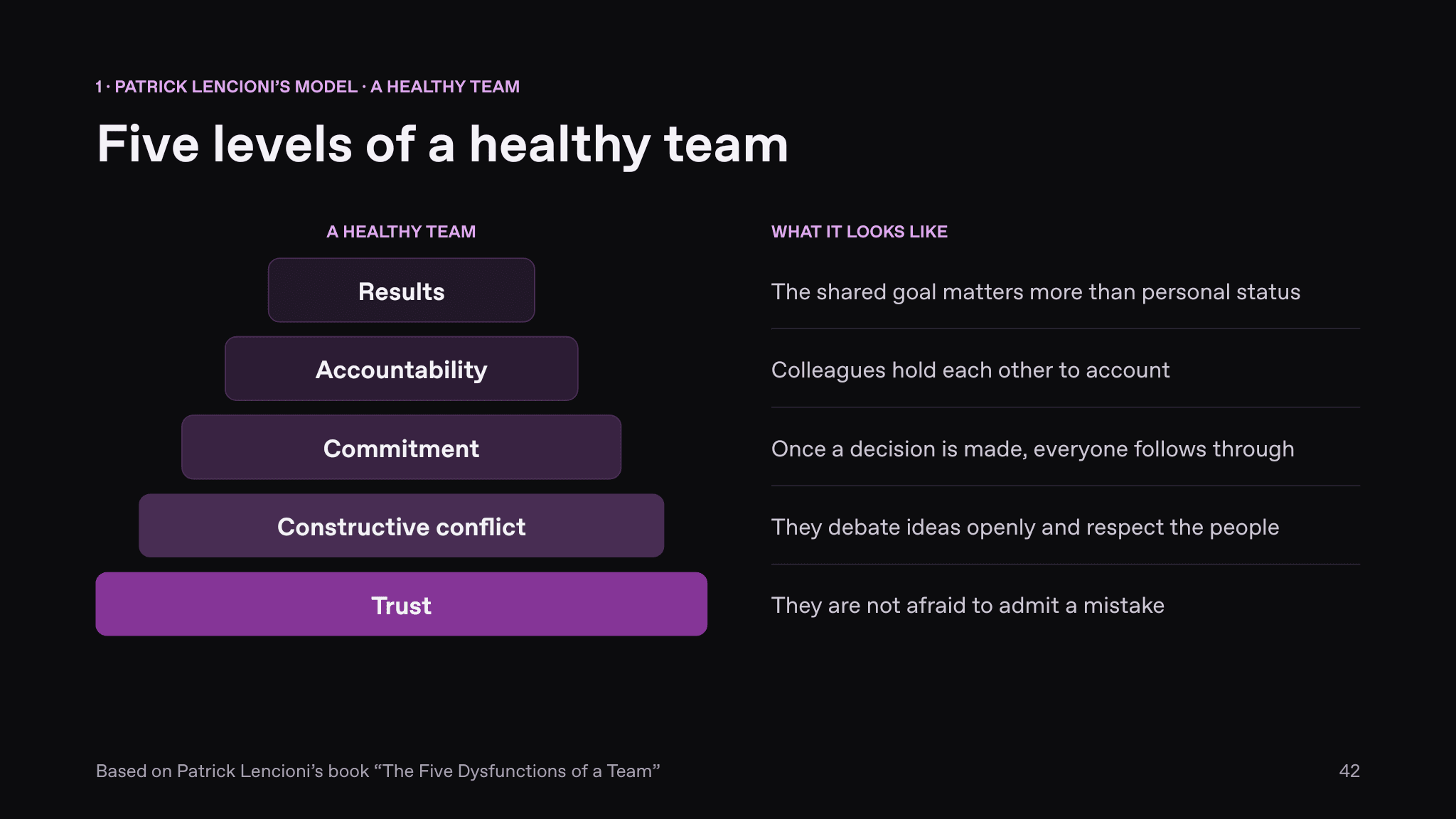
Patrick Lencioni's 5 tiers of team health
Team dysfunction escalates sequentially from the foundational layer upward:
- Tier 1: Absence of trust → hidden errors. Staff conceal mistakes out of fear of punishment.
- Tier 2: Fear of conflict → artificial harmony. Team members nod passively in meetings but vent frustration privately.
- Tier 3: Lack of commitment → passive sabotage. Without open debate, staff feel zero ownership and execute half-heartedly.
- Tier 4: Avoidance of accountability → lowered standards. Peers ignore underperformance ("not my responsibility").
- Tier 5: Inattention to results → ego & status first. Departments protect silos while company-level strategic goals fail.
4. Decision frameworks & high-stakes conversations
In a crisis, two things decide how fast a team recovers: how quickly the leader makes a decision, and how clearly the leader handles a hard conversation. This section covers a tool for each. Jeff Bezos’ two-door model sorts decisions by how costly they are to reverse, and the SBI model gives a difficult conversation a structure built on facts instead of emotion.
Jeff Bezos' two-door model & the 70% rule
Crisis management demands rapid decision-making velocity. Bezos categorizes all decisions into two distinct types:
- Reversible decisions (door 1): Tweaking marketing campaigns, adjusting shift schedules, testing menu items. Causal dynamic: Reversing a mistake costs minimal capital. Rule: Decide rapidly using ~ 70% of available information and delegate fully.
- Irreversible decisions (door 2): Executive terminations, major capital expenditures, selling business assets. Causal dynamic: Reversing an error is impossible or ruinously expensive. Rule: Decide deliberately, personally, with a mandatory overnight pause.
The SBI model for difficult conversations
Addressing performance gaps emotionally triggers defensive pushback. The situation-behavior-impact model provides an objective structure:
- Fact (situation/behavior): "This is the third time this month that the end-of-week report was delayed by two days."
- Impact: "Because of this delay, finance cannot process vendor payments on schedule."
- Emotion / stance: "I am concerned because this damages our vendor trust and operational reliability."
- Question (with mandatory 5-second silence): "What is happening on your side?"
- Agreement: Document explicit next steps, target dates, and review checkpoints.
5. Synthesis of live workshop Q&A & crisis simulations
Three questions from the workshop show how the playbook holds up under real pressure, and a crisis simulation from Irpin applies it end to end. Each case follows the same pattern: the root cause, how it spreads, and the resolution.
Case 1: "Managing technical specialists who exceed the leader's expertise"
- Root cause: Leaders falsely assume they must possess superior technical knowledge in every domain.
- Causal dynamics: Attempting to out-expert senior technicians demoralizes specialists and turns them into passive order-takers.
- Resolution: The leader acts as a system architect (Meaning + Structure + State), not the top technician. Hiring specialists smarter than yourself is the hallmark of effective leadership.
Case 2: "Key employee departures paralyze operations"
- Root cause: Niche operational knowledge is trapped inside a single employee's head.
- Resolution: Mandate a peer backup system. Employees cross-train backups and document standard operating procedures (SOPs) prior to taking leave.
Case 3: "Svitanok Bakery crisis simulation (Irpin) under blackouts"
- Context: Extended grid outages combined with delayed client payments (+39 days delay).
- Resolution: Activate crisis protocol: prioritize generator power to fulfill commander's intent (school bread delivery at 7:00 AM), freeze non-essential feature development, and manage team communication via asynchronous channels.
Business plan "team & management" & 30-day checklist
Start with the organizational chart. It maps every role in the company and marks each single point of failure in red, meaning each function that one person alone can perform. The red marks show an investor where the business would stall, so you see them first and can plan to remove them.
Next comes the delegation roadmap. Audit 10 to 15 of the company’s functions and place each at its current level of autonomy, from show through accompany and check to trust. Then set a target level for each function. The roadmap turns “we plan to delegate” into a sequence the team can follow and an investor can check.
The role scorecards define each key role by its deliverables and its authority boundaries. They separate the role from the position, so anyone covering for a colleague knows exactly what the job produces and which decisions it can make without asking.
The operational cadence sets the rhythm of oversight. It lists daily 10-minute standups, weekly metric reviews, and biweekly one-on-one syncs. A fixed schedule replaces random check-ins and gives the team a predictable place to raise problems.
The crisis protocol states the escalation rules for two situations: a blackout contingency and the owner’s absence. It tells the team who decides, who covers, and when to escalate, so nobody waits for an order that cannot arrive.
30-day executive action plan
This 30-day plan turns the playbook into action, moving from an audit of your team to a business that keeps running without you at the center.
Week 1 (days 1 to 7): audit the four pillars:
- State: Start the oxygen mask routine and ask three trusted people how you come across under pressure.
- Meaning: Ask four or five people to state today’s priority and its limits. If the answers differ, write your commander’s intent in one sentence.
- Structure: Mark every function only one person can perform in red on your organizational chart, and count the red marks.
- Dynamics: Review your last two weeks of check-ins and note which were scheduled and which were reactive.
Week 2 (days 8 to 14): build structure
- Name a peer backup for every red function. Each backup writes the standard operating procedure (SOP).
- Choose three routine functions that repeat daily or weekly, and start the Show stage.
- Write your Manual of Me, have two honest colleagues review it, and share it with your direct reports.
- Create role scorecards with deliverables and authority boundaries, starting with the three delegated roles.
Week 3 (days 15 to 21): set the rhythm
Put the operational pulse in the calendar: a daily 10-minute standup, a weekly metric review, and a biweekly one-on-one.
- Move the three functions to Accompany.
- Sort your decisions by door: delegate reversible ones, keep irreversible ones with an overnight pause.
- Hold one SBI conversation and write a one-page crisis protocol.
Week 4 (days 22 to 30): test and lock
- Run an absence drill of half a day to two days on the crisis protocol, then fix what stalled.
- Move the functions to Check. Advance only after two to three clean cycles, so Trust is the month-two goal.
- Draft the cost-reduction roadmap for a 30% revenue downturn.
- Re-score the four pillars against day 7 and recount the red marks.
Special thanks to the Rebuild 2 program partners (Diia.Business Bucha, BMZ, Aktion Deutschland Hilft, and ASB Ukraine) for supporting local business resilience and economic recovery in Ukraine!